.Davis Typewriter Works

.Davis Typewriter Works

Monday, May 25, 2015

The Victor Standard Typewriter

Victor No. 3; Davis Bros. collection

The Victor is one of those typewriter brands which collectors today view somewhat as an oddity, or else as an "off brand" or "also-ran" make.  The Victor lasted in production from 1907 through perhaps 1925, giving it a short life when compared with big makes such as Remington or Underwood.  Yet the Victor has a special place for some collectors, and for that reason we've decided to give a complete history of this machine as we did previously on this blog with the Harris - Rex - Demountable line of machines, the Reliance, and the Burroughs.  This material supersedes that on my old website.

THE VICTOR'S BEGINNINGS

The Victor did not appear from a vacuum; it had its roots in persons involved with an established manufacturer of typewriters.  The Franklin Typewriter Company was that entity from which the Victor developed.

In 1902, the Franklin Typewriter Company of New York, which was manufacturing a machine of that name and which had been invented originally by Wellington Parker Kidder, was declared bankrupt.  The Franklin was a workable typewriter, but was not exceedingly modern and not particularly competitive - but still, it was better in ways than a number of other machines holding out on the market.  The company was sold on October 18, 1902 to one Robert J. Edwards for a sum of $12,222.  The company's tooling had been valued, by assessor, at between six and seven thousand dollars and its factory equipment at about fifteen hundred.

In 1904, the newly reorganized company brought the No. 10 Franklin to market; this would be the final model of this series.  In 1905, the company - perhaps spurred by the then-recent (1904) introduction of the visible-writing L.C. Smith machine, and its direct competitor the Monarch at the same time - began to work on a true $100 front strike standard machine.  The timing of this move is notable, as at this time the Remington, Smith Premier, Yost, and Fox standard machines were all still understrike or "blind writer" designs.  These plans were not announced to the industry.

The new Victor (taking the name of an index style predecessor of the Franklin) was brought to market in May 1907.  One month before this move and concurrent with injection of new capital, the Victor Typewriter Company had been incorporated and had taken over all interests of the older Franklin concern.  The Franklin design was dropped.

VICTOR NO. 1


The Victor No. 1 as introduced to the market in the second quarter of 1907 was a four bank, front strike machine of the general $100 class in all measures such as weight, size and capability.  The keyboard incorporated 42 keys typing 84 characters, with a single (carriage) shift.  The machine had several features which were notable in comparison with other new visibles such as the L.C. Smith or Monarch; for example, every Victor came out of the factory with a decimal tabulator as standard equipment but at no added cost.  The Victor had an outstanding and unique mounting design for its type bars wherein each had two legs attached to the mounting bar one inch apart - a feature intended to absolutely prevent bearing wear from working the machine out of alignment.  The bearings were also adjustable to take up for wear.  Oddities with the machine were its ribbon vibrator, which ran the ribbon vertically at the print point (it being fed by spools under the top deck and having two colors) and the machine's physical setup that ensured the printing was done above the horizontal on the platen.  This latter feature was intended to assist with visibility of the typing in areas not exceedingly well lit; not all typists had desks by the window, and not all offices were well lit in those days.

In the interest of comparison with other standard makes available at the time, it should be pointed out that the Victor was never available as separate concurrent models; other makes, such as L. C. Smith, Monarch and Underwood had two or more models available concurrently with differing numbers of keys and/or wide carriages.  Also, the Victor was unavailable without the decimal tabulator - in keeping with the "single model" concept.  Indeed, throughout its entire life the Victor would never have more than one model offered at one time.

The machine was manufactured in a factory at 812-814 Greenwich Street, New York City as seen below in an illustration from Business Equipment Topics.


This factory building still stands today, in wonderful condition at 812-814 Greenwich St., New York City.  Click here to see it on Bing Maps.  It is now refurbished as high end housing.

As mentioned, the Victor entered the market at a time that the Underwood was moving toward dominance of all other $100 machines, but into which the new and "visible" L. C. Smith and the Monarch had appeared.  Within a year or so of the introduction of the Victor, however, the big Union makes changed over to visibles -- the Remington and Smith Premier machines being the most well known.  Right before the Victor's introduction, the Fox had also changed to a visible writer .. and there were numerous other lesser machines around as well as a flood of rebuilt blind-writers with which to compete.

The Victor No. 1 was actively marketed mainly in the United States, although it did appear in Europe where it was marketed as the DIKTATOR.  This early marketing of the machine overseas was however inconsequential when compared to the efforts undertaken later in the life of the machine's descendants.

DIKTATOR, in the Thomas Fuertig collection.  Note refitting of horizontal path ribbon guide.

As with all new machines of any sort, time discloses deficiencies or weaknesses and responsively the company introduced a number of changes with a new model after having sold roughly 3000 examples of its first model.

VICTOR NO. 2


December 1909 saw the introduction of the Victor No. 2, which in overall appearance and general arrangement followed closely after the No. 1 but which incorporated a very large number of improvements and alterations.  These included the following:

•Change of primary key levers from wood to metal, and change in mechanism design
•Addition of new and novel ribbon color selector device, on front, with distinctive guide
•Back space key (mounted as bar above keyboard, center)
•New carriage rail and bearings
•New escapement
•Variable line spacing
•Improved paper finger design
•Provision for individual adjustment of key lever tension

Retained in the machine's features were the decimal tabulator, the ribbon arrangement, and the orientation of assembly that made the machine type just above level, as it were, on the front of the platen.  Wide carriages had been introduced just immediately prior to issuance of the No. 2 model in 1909.

The Victor Typewriter Company soon found itself in a position to announce somewhat of a sales coup, as it was the Victor that won out over a number of other standard makes in a competition held by International Correspondence Schools of Scranton, Pennsylvania.  The purpose of this competition was to determine which make ICS would use for its correspondence typing and business courses -- for which it would be shipping off not just the courses, but $100 typewriters.

ICS placed an enormous order in January, 1910 for no less than 7,500 Victor typewriters to be used not only for its correspondence work but also by special arrangement in all of its own offices and plants.  This was one of the largest single orders of its time, and represented over twice the entire production that the company had achieved of the No. 1 model in two and a half years.  This order also began what would prove to be a close relationship between the Victor concern and ICS until the complete shutdown of the business in the 1920's.

INTERNATIONAL TEXTBOOK TAKES OVER

After a period of two years and three months the Victor No. 3 model appeared on the market; introduced in March 1912, the machine had a number of small improvements over the No. 2. In its general arrangement, main operative features and mechanical design it was not at all dissimilar from the preceding model.  As it happens historically, the No. 3 would be the major production model for the company; it would last on the market for about seven and a half years.  It continued at $100 price as with the previous offerings.


Victor No. 3 ad, Auto Trade Journal; date unknown, Will Davis collection

When the new model hit the market, ICS announced that it had over 2,000 Victor machines in its service (of all models) whether that be for use by correspondence students or for use in its own offices and plants.  Whether the commitment for a further 5,500 machines to ICS played a role in what happened next is not certain, but seems important given the ICS commitment to its correspondence program - but whatever the case, Victor soon found itself in new hands.

In September 1912 it was revealed to the trade that Robert J. Edwards had sold the Victor Typewriter Company to ICS affiliate International Textbook Company including all patents, tools, facilities and good will.  A letter by inventor George W. Campbell (intimately involved with the Victor for years) to Business Equipment Topics stated that this transaction "benefited Victor in every way." In point of fact, the Victor concern was seriously in trouble, and it is a good bet that ICS bought it partly to save it, partly to ensure its supply of typewriters, and partly due to the desire of  Thomas J. Foster - head of the ICS companies - to become somewhat of a business magnate in the vein of the Vanderbilts or the Morgans.

The various Foster enterprises, which included not just ICS but mining and railroading interests among others were all headquartered around Scranton, Pennsylvania.  Financial magazines of the day made note of the interconnected finances of the Foster enterprises, the apparent seamless movement of money between them (and even mergers of them) and both the frequent convulsions of their financial conditions and the resultant pleas to investors for more cash.  None of the ventures was highly profitable -- the entire Foster empire was a house of cards it was said, and in point of fact the addition of Victor to the fold made the conditions worse, not better.

The periodical FINANCIAL WORLD was never kind to T. J. Foster or his ventures, it would seem, and right from the start it questioned the purchase of the typewriter concern by ICS/ITB, noting in November 1912 that financials for the Victor concern were generally impossible to find but that $1,000,000 had been raised by Foster to buy the stock of a company which had multiple small judgments (in other words, lost lawsuits) against it.  The picture then was of a company so cash deficient it could not pay its bills but yet for which Foster had managed to get a million dollars from investors.  The contract for the 7,500 Victor machines was valued (at the time of ICS purchase of Victor) at about $850,000.


Already in October 1912 FINANCIAL WORLD had directly accused Foster's companies of continuing to offer bad securities after good, so that increasing monies taken in were used mostly to pay old debt.  The periodical wrote of the Foster companies "it is a long chain they are running, but it is no stronger than its weakest link."  Soon the company would attempt to offer a SECOND block of stock totaling $1,000,000.

SHOPPING AROUND TO UNLOAD VICTOR

Before three years were out the condition of International Textbook Company had become rather acute - and so had the condition of Foster's empire.  The outbreak of war in Europe had led to a reduction in sales of all kinds, overseas first and then in the US; hard hit of course were correspondence courses.  According to testimony by Foster a couple years later in an unrelated personal bankruptcy case (not Foster's), just as the War broke out Victor was attempting to establish a conventional sales and dealer network (which implies an outlay of cash to purchase or rent properties and hire and train personnel.)

As early as May 1915 reports began to appear that Int'l Textbook was shopping around for buyers for Victor Typewriter and a new location for its factory.  The May 8, 1915 AMERICAN STATIONER reported that Victor officials were scouting the town of Lynn, Massachusetts and discussing a $1,000,000 deal to locate a manufacturing plant there.  Representatives of the Lynn Chamber of Commerce showed the typewriter men the city.  Nothing came of this proposal, although it did make press a number of places.

However also in May 1915 FINANCIAL WORLD reported that Foster himself was courting the city of Columbus, Ohio to erect a new factory for the Victor.  Foster was proposing that Columbus businessmen underwrite an issue of $5,000,000 worth of 7% bonds; the factory would provide employment for 1500 people, Foster reportedly said.  The publication (more skeptical of Foster than ever) noted the dire condition of the home businesses back in Scranton and jokingly noted that Foster would build a factory in Kamchatka if he could get an infusion of five million dollars.

By the end of May Foster had made another proposal to the businessmen and bankers of Taunton, Massachusetts - this time an issue of $2,500,000 of twenty-year bonds on a basis of 7% return.  FINANCIAL WORLD at this time (May 29, 1915) noted the sorry history of Int'l Textbook and the Victor stock since purchase, with continual recapitalization being required.  "So it goes on, weaving and weaving new securities out of the shreds of an old carpet.  It is an unending process of capitalizing and recapitalizing the same old proposition.  This has naturally and justifiably raised over the whole edifice a black cloud of suspicion," the publication went on to say; it added some details of other financial maneuverings inside the Foster empire to patch holes here and there, and even some bankruptcies.

Victor No. 3 w/ original crate; Davis Bros. collection


By June 1915 the situation of ICS and Int'l Textbook was absolutely critical.  At the 1915 Int'l Textbook Shareholder meeting, Foster himself announced that cash receipts were down for the preceding year over three quarters of a million dollars and this, coupled with rapidly rising expenses had driven available cash to just $100,000.  The company had paid its dividend in January and originally intended to pay April's (and declared it) but then rescinded the April dividend.  The stockholders then voted to authorize an emergency issuance of $1,000,000 in bonds, to be secured by physical property and real estate.  However, none of these bonds sold (even through March 1918.)  It was reported in August, 1915 in THE AMERICAN STATIONER that it was the Victor Typewriter Company's financial condition that was largely responsible for the bad condition of International Textbook Company.

At this time - August 1915 - the Chamber of Commerce of Lawrence, Massachusetts was now reported to be considering whether or not to arrange a deal to buy the company and bring it to Massachusetts. The August 14 AMERICAN STATIONER reported that a letter was sent from the Chamber president to businessmen in Lawrence showing that the condition of Victor Typewriter was not great, having for example only about $28,000 in cash above all outstanding liabilities, but that if any eight business men in the town could each put in $1000 then eight seats on the Board of the new company could be secured and the company brought to Lawrence

What had in fact transpired in the interim between the first visit of officials to Lynn and the present offer for Board seats in Lawrence is that a deal had been struck between Int'l Textbook (Foster) and George W. Campbell (mentioned earlier) to buy out the entire typewriter business from Int'l Textbook.  It was now left for Campbell and his group to discover just where a new factory would be either bought and converted or else built and fitted.

Victor No. 3 illustration courtesy Peter Weil

By October 1915 the deal with Lawrence businessmen had fallen through.  Instead, Campbell and partners incorporated a new Victor Typewriter Manufacturing Company (incorporated in New York) to buy the concern and build a new and large factory in Poughkeepsie, New York.  The capital stock of the new corporation was $2,625,000 (a decent figure, since the Lynn officials earlier had found the capital stock of Victor to be $1,780,000 and the total assets to be $1,267,580.)

November 1915 brought wide announcement of a bright future for Victor.  Trade papers showed artists' renderings of the new, large and modern plant intended for Poughkeepsie, which was designed by architect John J. Petit of New York.  The $1,500,000 plant would include every modern feature and according to AMERICAN STATIONER "it is the company's idea to surround its employees with every element which will be conducive toward their comfort and efficiency of their work."  The new plant would incorporate its own power plant; it would not be ready over a year.  In that month TYPEWRITER TOPICS reported that it was primarily the financial condition of Int'l Textbook that led investors to buy out the typewriter concern.

BACK TO THE DRAWING BOARD

And then the new deal, the massive factory, the new ownership failed.  The deal was not consummated; the new company did not take over.  Not one brick of the new factory was put up.  Production of the No. 3 Victor went along as before on Greenwich St. in New York.

International Textbook, according to V. P. Ralph Weeks, 'reorganized the operations of the company' to secure profitability in what it believed would be the near term.  And things began to actually look up.

In 1916, a number of positive things happened. The company decided to sell some of its sales offices in smaller business areas and hand over the dealership rights to typewriter businesses already established in those locations.  In England, Salter Typewriter Co.'s factory was being used for war purposes -- so it arranged to sell the Victor typewriter through its dealer network.  This meant that Victor gained a new, ready-made (if temporary) sales network in England and that Salter could maintain its network for the time when the war was over.  And the Boston Board of Education, after considering various models for two years, ordered 1,000 Victor typewriters.

The announcement was made in May, 1917 trade papers that the entire equipment of the Victor Typewriter Company was underway by rail to a new home - a factory space erected for it on the property of International Textbook Company, in Scranton Pennsylvania near the other major operative buildings of the company.


The plant occupied by Victor Typewriter from May 1917 onward still stands today in Scranton, Pennsylvania and is seen above in a screen shot from Bing Maps.

There is also evidence that in late 1917 the company set up a subsidiary to handle its machines after rebuilding and/or traded in machines - the formation of a "Victor Typewriter Sales & Supply Co." is noted in several sources and in September 1917 the company advertised that it had "a number of overhauled, perfect condition second-hand machines that had been traded in on the new Victor No. 3 model."  This company was also located in Scranton, Pa.

However in 1917 International Textbook and ICS reported that they had lost over 12,000 correspondence students as a result of the War just in the period from May to December 1917.  Clearly though as seen above the company had made moves to establish sales through conventional sales practices, so that the typewriter business was not directly affected by this loss (which was not by any means limited to just correspondence courses that required typewriters.)

THE NEW VICTOR NO. 10 AND NEW OWNERSHIP


In November 1919 the Victor No. 10 was announced to the trade.  This machine was a thorough revision of the previous general design; while it incorporated the same key lever and type bar mechanism and the same bearing design for the type bars, a large portion of the machine was "rationalized"or made more like that of other standard machines of the day.  The ribbon spools were brought out from under the top deck and placed on top of it; the type basket was reoriented so that impression now occurred level on the front of the platen; and the whole of the carriage assembly was brought up and forward toward the typist to improve access and reach. At the print point, the former vertical orientation of the ribbon was dropped in favor of a wholly conventional ribbon vibrator.  The decimal tabulator design and the ribbon selector quadrant design were retained, but a host of minor other improvements was made and the new machine (which now sold at $110) was said to contain "nearly 100 fewer parts" than had the previous models.  The Victor No. 10 is often erroneously described in collector publications by its platen width (10-1.2 inches) as a model number - but the model is No. 10 nevertheless.  The company expected first deliveries on or about January 1, 1920.

Victor No. 10, courtesy Thomas Fuertig.
Victor No. 10, courtesy Richard Polt


At the same time as the much improved No. 10 was announced, the company began construction of an addition to its Scranton, Pa. typewriter factory.

The year 1920 saw an event that had been attempted numerous times before but which had failed brought to fruition; the Victor Typewriter Company was sold by International Textbook to a concern headed by Everly M. Davis.  The periodical UNITED STATES INVESTOR reported in 1921 that International Textbook had "disposed of interests in Victor Typewriter" during the year 1920, but other sources show the date of changeover being February 1921.  It is possible that the deal was signed late in 1920 and not effective until February of the next year.  Whatever the case, the company was now on its own feet.

An important change that had been progressively occurring in the matter of sales of the Victor was an ever-increasing focus on the export of the typewriter outside the United States.  Earlier in this piece Foster was quoted as saying that Victor was only just establishing a sales network at the time it was purchased by International Textbook; at an international trade convention in Cleveland, Ohio in 1921 Victor Typewriter President Mayne R. Denman told the assembled crowd that when the war had broken out, his company was not exporting.  He did point out that after concerted effort in the field, it was now exporting 80% of its product.  He mentioned that some companies who had been exporting pre-war were referring to new exporters as "wild-catters" (a derogatory term) but he said that he felt the new exporters had every bit as much right to build business as old exporters had.  Denman also brought up the problem that some South American opportunities had been stymied because prospective customers had been cancelling orders; the required purchase of raw materials for these had taken place in some cases a year in advance, so that when the customers ultimately cancelled the costs for the whole process were thrown onto the manufacturer.

Victor No. 10 courtesy Tilman Elster.
In June 1922, trade paper Business Equipment Topics reported that production of the Victor No. 10 during that month was greater than during any other month for the last year and a half, and that the company was essentially 25% overbooked in sales vs. actual production.

THE END

We do now know the exact turn of events (yet) that surround the collapse of the Victor Typewriter Company, although the worldwide recession of the early 1920's is unavoidably contributory.  What is clear is that for some reason or another, in March 1924 Business Equipment Topics reported that ownership of Victor Typewriter Company had passed BACK into the hands of International Textbook Company.  In point of fact, back in June 1922 (the same month that manufacturing was reported to be at a high point) it was also reported that two whole floors of a building at Scranton that had formerly been used by Victor were being re-purposed for other uses.  It is quite contradictory to find that Victor's production was at a peak and that it was giving up floor space -- but the nature of a trade paper is first to promote and second to report.  Thus it was very likely that production of the machine had not been vibrant at all for some time, and that the reported "peak" in manufacturing was more of a last gasp than an augury of future success.  Whatever the case, the death of the concern was near at hand.

Moody's reported that Victor Typewriter Company had (in 1924) about $568,000 in notes outstanding to International Textbook.  This must partly explain ITB taking control of the company once again, and indicates the company's cash-deficient position.

References to existence of the company can still be found in 1925 publications - but not in 1926.  In 1926, the Victor Adding Machine Co. paid Victor Typewriter $15,000 for "rights and good will" concerning the name "Victor" for typewriters, as it intended to launch a portable typewriter of indigenous design and wished to use its name for the typewriter.  At this point, this was probably the largest payment Victor Typewriter could have hoped for, and surely this was an aid in the dissolution of the company which must have occurred at about this time.

----------

PERSPECTIVE AND ANALYSIS

Victor Typewriter Co. manufactured four models over the span 1907-1924.

•Victor No. 1 /  May 1907 - December 1909 / serials 0 to ~3000 (3000 units)
•Victor No. 2 /  December 1909 - March 1912 / serials 3000 to 7500 (4500 units)
•Victor No. 3 / March 1912 - December 1919 / serials 8000 to 25000 (17000 units)
•Victor No. 10 / December 1919 - ? 1924 / serials 50000 to 55000+ (about 5300 units)

When the Victor machine was first conceived about 1905 the market was still responding to the Underwood; the brand new visible, front strike L. C. Smith and the similar Monarch were making enormous waves in the trade press, and the push toward all standard machines being visible writers had just begun in earnest. (The Oliver also continued to be a force.)  The Victor just barely beat the Remington and Smith-Premier visibles to market in 1907, but it had been beaten to market by the Fox and by the brand new Royal, both of which had appeared in 1906.  The Royal had two models - a $100 and a $65, both described as "Standard" machines.  In the same time period the short lived Remington-Sholes Visible appeared, and quickly disappeared.  Sun Typewriter Company had introduced a $100 machine (its No. 6) to complement its line of lower priced front strike machines.

The Victor has, as a product line, a peculiar distinction -- Most $100, small brand machines introduced in the USA later than it did failed or at least did much worse than it did; these include the Blick-Bar, Remington-Sholes Visible, Secor, Sholes Visible, Stearns, and Visigraph.  The Woodstock, introduced 1914 was later but as we have described in one of our videos was not initially a $100 machine because of the issuance of "credit drafts" with each machine during early years, bringing the price under $70 (a policy which was not maintained, but rather kept long enough through production of the Woodstock No. 4 to ensure spread of the product.)  We thus can provide a pinpoint in history for the Victor as about the last "off brand" $100 standard to make it.

Rebuilt standard machines available at good quality but half the price of new standards seriously began to make inroads as increasingly they became available at this same time; additionally, a number of ostensibly "standard" but lower priced and less well featured machines such as the Harris Visible, the Pittsburg Visible (later Reliance), and others such as the Molle populated the same price range as the better rebuilt machines.  In other words, competition was fierce.  The First World War had a serious effect on sales; the increase following it was more than blunted by the world-wide recession of the early 1920's that killed off so many manufacturers (not just Victor, but Reliance and Fox to name a couple.)

Victor No. 10 trade catalog illustration courtesy Peter Weil
As originally introduced, the Victor had some features that appear to us today to be peculiarities, but in the world of typewriters such as it existed at the time none of these would have been especially glaring.  However within just a few years it became clear, for example, that having ribbon spools on the top of the machine for the sake of convenience was preferred, and in ways the Victor became more and more out of date domestically.  Export sales clearly helped bolster the machine, though, and after some years the design was heavily modernized and relaunched at the start of 1920 as the No. 10.  This model only sold about five thousand machines before the company failed.

At no time was Victor in any position to steer the overall field.  Its machine was good, but no better than the other $100 makes and had nothing especially to commend it.  Instead it remained an "also ran" for its entire career - although it maintained its high market price to the end.

Victor No. 3, Davis Bros. collection
COLLECTORS TODAY AND THE VICTOR

Victor standard machines were superbly painted, decaled and finished, and are very often found in a condition that surprises.  For four bank front strike standards, the Victors draw a premium price.

Numerous Victor machines were rebuilt and relabeled by Chicago-area rebuilder Harry A. Smith Typewriter Co. and can be found with this brand name and variously given the Harry A. Smith model numbers of 2, 4, and 6 (rebuilt Victor No. 2 machines) and 9 and 12 (rebuilt Victor No. 3 machines.)

With something over 30,000 Victors of all models built, the Victor as a brand is roughly as common as Demountables of all models (about 25,000 built) but considerably less common than Harris Visible / Rex Visible machines of all models (about 70,000 built.) Roughly three times as many of the ornate, open sided (German built) Ideal machines were made as were made of all models of the Victor, as a poignant comparison.  Certainly then a Victor of any model should be on the wish list of any collector interested in early or unusual front strike standard typewriters.  Serious typists (in other words modern writers) should only pursue the No. 10 model, if any at all.

LINKS

Typing test!  My Victor No. 10, tested back in January 2011.

Harry A. Smith page on this blog features details on rebuilt Victors

SOURCES

As noted in the text - includes various issues of Business Equipment Topics / Typewriter Topics, The American Stationer, American Machinist, Poor's Manual of Industrials and Public Utilities, Automobile Trade Journal, Educational Foundations, United States Investor, Typographical Journal, and Financial World.  Black and white typewriter cuts taken from Business Equipment Topics (Victor Typewriter Co. advertisements.)  All other illustrations and machines shown, see individual captions and descriptions.

Machines in Davis Bros. collection include a Harry A. Smith No. 4 (Victor No. 2), a Victor No. 3 and a Victor No. 10.


Tuesday, February 10, 2015

Portable Typewriters Today - February 2015

In the days of my old website I carried out, from time to time, updates on the portable typewriters that were actually being manufactured around the world.  There was a fairly static page until February 2005, at which time I began making some semi- regular updates on the changes in the typewriters available for purchase brand new.

Now, TEN YEARS LATER, I'm going to revisit that series of articles by doing two things:

•First, an update of the manual portables available right now.
•Second, an archive of the information written from 2005 onward on my old site to record the winding down of the manufacturing and sales of portables in the USA.

PORTABLES TODAY - FEBRUARY 2015

Incredibly, we find that one of the oldest names in the business continues to offer a portable manual typewriter on its website.

The Royal Epoch is available for $199.99 at Royal Consumer Business Products' website.  This machine is manufactured for Royal in China by Shanghai Weilv Mechanism Company.

Manual Typewriter - available at Sharper Image for $199.99 and listed "in stock" today, February 10, 2015.  This is the same machine as that sold above as the Royal Epoch.  No model name or number is shown on the illustrations available.  An illustration of the machine from the site (appearing here for archival purposes in anticipation of that date when this offer is ended) is below.

Wordsmith's Manual Typewriter

Machines using this name - which actually looks like a marketing scheme and not a name applied on the typewriters themselves - are presently listed two places and are the same machine as the Royal Epoch and that sold by Sharper Image seen above.

Hammacher Schlemmer lists the machine for $249.95 and as of February 1, 2015 listed it as being available from its New York store. However a check today February 10 shows the machine as no longer available.  Thus, we've just seen the end of one line of distribution this month.

Skymall lists the machine for $249.95 noting that it is sold through Hammacher Schlemmer but says that the machine is presently unavailable. 

(Also, quite differently to these Robert E. De Barth is still showing the old Olivetti MS25 manual as available but has no price.  This machine is not the same as those shown above, but rather is the same as the recent "Generation 3000.")

The above applies to machines available in the United States directly to consumers.

Manufacturing of mechanical or manual portables in 2015 is, as was last reported on my old website, limited entirely to Shanghai Weilv Mechanism Co. in China, although this company is manufacturing (or at least advertising) several different actual mechanical designs.  It is not known if it is making these all continuously or is making them in batches.  The company describes itself as having two production lines, and employs less than 100 people.  Basic models being made are as follows:

"Carina / Carina 2" series

These typewriters are based off of what had been sold as the Olympia Carina in days past; they're derived from Nakajima originally and are the same as seen above in this post except for the De Barth offering.  Some variants of this machine are offered in black, some in white; some carry the ROVER brand name, and some do not.  Carriage widths available are 11", 13", and 18".  Below are shown the black "2013 New Model" with 11" carriage and the SM18 with 18" carriage.


Rover (IMC) Series

This series of typewriters is derived from the old IMC make in Italy, whose tooling was sent to China some years back.  This machine is the intermediate size machine being made by Shanghai Weilv, and is available in 9", 9.5", 11" and 13" carriage sizes.  The manufacturer claims to be able to supply 3500 machines per month.  Below is one of the various ROVER branded machines of this mechanical series.


Traveller C

Finally, the smallest machine is that whose mechanical origin is the Silver-Seiko small machine, which at the last was made for Olympia as its Traveller C model.  This machine is now offered in 9" or 9.5" carriage width as the Rover Traveller C, pictured below.


----------  ----------  ----------  ----------

That does it for machines being made right now.  The Shanghai Weilv offerings may indeed be for sale outside the US through various retailers, but they're only available wholesale from the manufacturers in minimum lots of 1000.

Now, we're going to jump all the way back to TEN YEARS AGO, using archived information from my old site, to give a timeline of the decline of the actual retail sale of manual portable typewriters in the United States.

----------

The Run-Down of Manual Portables in the US, 2004 - 2007.

As of mid-2004, machines still on the market included the Olympia Traveller C, and two offerings from Olivetti - the Lettera 25 and the Lettera 35l.    The machines were quite different; the Olympia had a snap over lid, carriage shift, and the lowest price of the lot.  The Olivetti machines were larger and heavier (although still of the "small" range of Olivetti portables) and incorporated segment shift, but had bag type carrying cases instead of a lid or actual hard case.

In the third quarter of 2004, both Olivetti and Olympia dropped their long running manual portables. In the case of Olympia, the end was complete; in Olivetti's case it immediately began importing machines from China which were advertised as the "Olivetti MS25 Premier."  Interestingly the MS25 was actually imported under the same model number in TWO DIFFERENT mechanical variations - a machine based on the old Brother, and another machine based on the IMC/Rover manufactured by Shanghai Aeroengine Manufacturing.  We noted at that time that the production of this IMC model had been taken over from Shanghai Aircraft Industrial Corporation who actually was a part owner of the new Shanghai Aeroengine firm; the product's brand name had been "Chang Kong."

At this time there had been machines advertised by Optima Erfurt as the Optima Traveller C, but these also disappeared when the Olympia Traveller C disappeared.

As of February 2005, also advertising manual typewriter manufacturing was Marshall Sewing Machine Industrial (located in Taiwan) offering its model MT-99 portable (a small machine resembling the Traveller C, but with a clear plastic paper tray on the carriage.)  Ningbo Duodashi Manufacturing Co. in China was offering its DUODASHI brand machine; it said at the time it began production in 1962.  Chee-May (Goh's) of Taiwan also listed many KOFA (Keeping Offices Fully Automated) models which included the Model 100 "mixto" or "Frankenwriter" whose design incorporated elements of two other previous machines (the main body of the old carriage shifted Triumph Tippa, merged with the carriage off of the bigger Olympia Traveller as made in Yugoslavia by UNIS, Sarajevo.)

Jordi Traveler, Will Davis collection.  "Model 100" rebranded.

In February 2005 the Olympia site still showed the Traveller C and two Carina models as available but since manufacture of the Traveller C was known to be terminated, these must have been backstock.

----------

In December 2005 we noted in another update that the Olivetti MS25 Premier, and the Rover 5000 were both available through a number of channels.  The perplexing thing (to some) was that either of these might show up as one of two different models.

The name "Rover 5000" was being used to cover two machines of different design, but which had the same number of keys, carriage width, and so forth.  One was based on the old original Rover 5000 made in China.  One of the old Rover 5000 machines is shown below for comparison.

Rover 5000, Will Davis collection.  Original series.
Machines ordered under either the Olivetti name, or through special interest catalogs like "Dr. Leonard's Health Care" wherein they were branded "Rover" might show up to the user either as the IMC/Rover family variant seen above or else as the Brother design based variant seen below.  (We actually did order one from Dr. Leonard's and below is what we received in December 2005.)

Rover 5000, Davis Bros. collection, acquired brand new 12/2005
The Dr. Leonard's Health Care catalog was a special interest mailer that primarily focused on products appealing to, or required by, senior citizens - and the typewriter was deliberately marketed in these with somewhat of a "throwback" angle.  The shift in focus of machines away from the old original product lines (as in Olivetti's case) and the introduction of the machines into "alternate" marketing like Dr. Leonard's points up the manual portable typewriter's position in the product life cycle at that time.

February 2006....   We discovered that the Signatures mail order catalog, offered by Starcrest Products of California, Inc. included a manual portable - the "Generation 3000."  We sent for one.

Generation 3000, Davis Bros. collection.  Acquired new 2/2006.
At this time we finally were able to discover that this particular design, based on what had originally been a Brother design, was being made by Ideal (Jinan) Machinery Co., Ltd. of China.  The Generation 3000 offering came in a very nice zippered vinyl case, as opposed to the snap over plastic lid of the Rover 5000... but both are the same typewriter.  The Generation brand name was owned by Generation Marketing Group, whose assignee was a Mr. Ashok Matta.  It is likely that this firm was the intermediary in arrangements between Ideal (Jinan) and the retailers.

The illustrations for the Generation 3000 included just a generic illustration of the machine with no name - a hint that the machines were offered under a variety of names and that a generic illustration was used.  See below.

Illustration in Generation 3000 inst.; Davis Bros. collection

At this time (Feb. 2006) the Carol Wright mail order catalog, which was loosely affiliated with the firm sending out the Dr. Leonard's Health Care mailers, also began offering the Rover 5000 typewriter.

For clarity then -- this Ideal (Jinan) design, based on the old dowel mounted key lever Brother machine, was being sold as the Generation 3000 (in black with zippered case), the Rover 5000 (in white with snap over case lid) and as the Olivetti MS25 Premier (also with snap over lid.)

----------

We didn't make another update on this topic until December 2007, when we announced the discovery of an elaborate offering of typewriters under the FLYING brand name.  The company manufacturing these was Zhangjiagang Feiteng Typewriter Co., Ltd. which was part of the Feiteng Group in China.  Offered were models Flying 300, Flying 800A, Flying 800B, Flying 880A, Flying 880B, Flying 960A and Flying 960B, all of which were related to each other mechanically and the Flying 970 which appeared quite like the Olympia Traveller C.

At that time the Marshall Sewing Machine Industrial model MT-99 was still being offered in large lots through multiple export opportunity sources.  Click here to see the link on Allproducts which is still active in February 2015 even though the machine is long deleted from the company's own site.  Below, the Marshall MT-99 from the company's illustration.  I have no idea whatsoever if the company ever actually manufactured more than a few of these machines.


At this time (December 2007) Shanghai Weilv Mechanism Company was only making machines based on the old IMC/Rover series that started in Italy, and only in two models -- the Rover 5000 and the Rover 8000. Some of the 5000 series machines were rebranded for Olivetti as the MS25 Premier.  Ideal (Jinan) Machinery Co. Ltd. was only making the one model, which was being sold in the US through Olivetti (also as the MS25 Premier) and through various catalogs.  The machine was advertised for a time on the Royal Consumer Information Products website but we reported in late 2007 that the machines had not actually been available.  Olivetti still controlled Royal at this time.

----------

Later years would see Royal split off into a private US-owned and operated company again... and now, in 2015 it is offering a mechanical typewriter over 100 years after the name appeared on the market.  There's no telling how long this will last, but it continues to fascinate me that every time we think the market has totally ended in the United States, another attempt is made.

On the world front, by all appearances both Ideal (Jinan), Flying, and Ningbo Duodashi are out of production.  We have no idea if Marshall Sewing Machine Industrial ever made any machines, really.  Only Shanghai Weilv soldiers on with three different mechanical designs, and apparently at least some kind of contract with Royal.  I'll keep my eye on things and make another update later this year.

Wednesday, February 4, 2015

Montgomery Ward's Reliance Visible Typewriters

Above is the front of a small, and quite delicate insert sheet that one might have found inside of a catalog or magazine; this insert is in my collection.  It was published by Montgomery Ward & Co., which for many years was the second largest general sales catalog mail order house in the USA (behind Sears, Roebuck & Co.)  There is no date on this little flyer.  The back side is below.
This might well be the first step anyone would take in ordering a typewriter for himself, herself, or for one's small office or home.  The time range in which this flyer was published -- roughly the 1916-1920 time period -- was that time period in which the typewriter as an entity, as a product, was moving from being a specialty item to being something that people felt they could, and possibly should, have as a personally (privately) owned object and not as property of a business or office.

The machine advertised is the Reliance Visible.  In point of fact, the machine and the factory to produce it in Kittanning, Pennsylvania were either owned by or completely contracted to Ward's at this point.  The Reliance Visible was, in many ways, to Ward's what the Harris Visible was to Sears.  The differences though are notable; for example, the Harris wasn't really seriously marketed widely until 1913 while the Reliance Visible had a pedigree going back to the 1890's and the Daugherty.  The Harris was a three bank double shift machine, while the Reliance was a four bank single shift machine which some collectors today might call a "gimmick" machine -- because the Reliance had a quickly removable key lever and type bar assembly for change of type.

We're here to take a look briefly at the Reliance and the trade catalog material, but let's first quickly identify the heritage of the Reliance.

Daugherty - Pittsburg beginnings

Daugherty Visible, courtesy JIM DAX

The Daugherty Visible was introduced to the market in 1891, and in fact predates the well known Underwood in the field of front strike, four bank typewriters.  Initial production was at the plant of the Crandall Typewriter Co., Groton New York but production was moved to Daugherty Typewriter Company's own plant in Kittanning, Pennsylvania in 1894.

The company's offering of 1896 is pictured below in an advertisement sent to us by Peter Weil.  Note the price for the machine of $75.00.

Daugherty Ad, 1896; Peter Weil collection
Important to note on this advertisement is the statement that the machine had the "Remington Keyboard."  This is an indicator of the time in which the machine was being sold; the conclusion that visible writing, four bank keyboard (single shift) machines would win out was not by any stretch decided firmly at this point - neither was it especially obvious.  In being a visible writing machine and in having the four bank single shift keyboard, the Daugherty was visionary.

In 1897, a problem with production caused the scrapping of 2500 machines at the factory.  This devastated the small company, with agents around the country compelled to cancel the orders placed should machines be unavailable.  The company was bankrupted, and was bought out; the factory was shut down for seven and a half months.

As a result, the Pittsburg Visible Typewriter Company was born and the machine became the Pittsburg Visible.  The "h" in the name Pittsburgh was not used for a time, and the company and machines reflect this spelling aberration.

Pittsburg Visible No. 10, JIM DAX collection
The typewriter continued to receive improvements (and continued to sell in the $65-$75 dollar range) into the 20th century.  The Railroad Telegrapher in 1905 contained an ad stating that the Pittsburg Visible held the world's record of 28,000 words in seven hours, and the telegraph record of 274 unsorted Western Union messages in 254 minutes.  The ad, put out by "Telegraphers Typewriter Co., Rialto Building, Chicago" also said that "we can give you names of telegraphers who have used this machine for ten years, handling from 100 to 200 messages per day without expending one cent for repairs."  The price was $75.00, payable $10.00 down and $6.50 per month thereafter.

Eventually the Pittsburg Visible was manufactured through the No. 12 model.  In 1910, the company came under control of Union Typewriter - the giant trust that included Remington, Smith Premier, American Writing Machine (by this time rebuilding typewriters, but formerly maker of the Caligraph), Monarch, Yost and others.  The company would last only three years under this ownership.  The original inventor himself remained with Union Typewriter until 1913, at which time he left to join Underwood Typewriter Company.   (Some historical points here.)

By 1912 the No. 12 had appeared - the final Pittsburg Visible model. By now the machine looked much more modern than had the thin, open early models. The machine was selling at $65 and according to advertisements by the company, most of the sales were by mail order.

Pittsburg Visible No. 12 serial 39284, David A. Davis collection
Peter Weil has sent us a bill of sale for Pittsburg Visible No. 12 serial number 37764, which was sold on September 6, 1912.  The price was $57.50 which might indicate a trade in was used.  Shortly the company would change the spelling from the previously used "Pittsburg Visible" and "Pittsburg Visible Typewriter Company" to include the "h" at the end of "Pittsburg."

The company entered bankruptcy on May 12, 1913 according to information sent us by Richard Polt.  Richard also informs us that in September 1913 the selloff of machines had begun; an ad in the New York Times told interested buyers that leftover machines were available at the New York office for just $39.00. One of the receivers of the company was Frankin L. Sholes, of the famous Sholes typewriter family. Typewriter Topics' 1923 compendium relates the fact that the manufacturing plant was sold on March 16, 1914 to one J. S. Kuhn of Pittsburgh, for $12,000.

On August 20, 1914, the manufacturing plant was shut down.  "Standard Corporation Service Daily" reported that the company's shutdown put "many men out of employment" and noted also that the company had been selling a large part of its output to Germany.  (The implication here is that the outbreak of war had cut off the company's sales.)

The total number of machines manufactured by Daugherty and Pittsburg did not exceed about 41,000 typewriters.  The companies had lasted twenty-four years, give or take; it would appear that the cutoff of exports, coupled with a business model that sold direct by mail only had done the company in.

It is important to note that by this time, the Pittsburgh Visible (as it was now known) existed in a storm of competition.  Established $100 machines on the market included the Underwood, Remington, L.C. Smith, Royal, Monarch and Smith Premier which were dominating sales.  Other lesser makes such as Oliver, Fox and Victor further crowded the field; the Woodstock was just about to appear and take a major place, and Sears, Roebuck had ordered ten thousand Harris Visible machines to sell in large volume through its catalog and through mail order.  Competition was serious; many various styles of typewriter - some index type, some keyboard type - were killed off in this period.

It was only through the effort of another large catalog sales outfit that the design we're discussing survived beyond this rough period.

Reliance Visible and Montgomery Ward

Reliance Visible trade catalog, Will Davis collection
Although there is evidence that the machine formerly known as the Pittsburgh Visible re-appeared under the Reliance name in late 1915, it is not until early in 1916 that Montgomery Ward begins heavily advertising the typewriter in various magazines, describing it as their own machine.  As noted, the direct implication of this is that the machine's entire production was contracted to Ward (as was the early arrangement Sears had with the Harris Visible) or else that Ward actually had controlling interest in or owned the factory.  Whatever the case, as of early 1916 the two biggest mail order houses in the world were now selling standard typewriters they were willing to put their brand names behind.

Will Davis collection
The page above not only describes Ward's faith in the Reliance Visible, but actually shows the machine being used in three settings in the offices of the company.  This is a direct parallel to the depiction of the Harris Visible being used in Sears, Roebuck offices in the Harris trade catalog.  Click the photo to enlarge it and read the particulars - and look at the Reliance machines in actual use.

The Reliance Visible was described by Ward's as incorporating the six features absolutely necessary for any machine to be considered "standard" - namely:

1.  Visible writing
2.  Standard keyboard (four row, single shift as opposed to three bank double shift or full)
3.  Fixed key travel distance of 9/16 inch - "It is interesting to note that all speed and endurance contests have for years been won by standard machines with 9/16 inch key depression and four rows of keys, both of which features the Reliance has," according to the brochure
4.  Light Shift Key Action
5.  A Light-Running Carriage
6.  Rapid Escapement.

Further, the machine was said to be of "standard design" (in configuration, fit and finish), "standard material" (high grade material and workmanship), and had "standard features" (the six required points, and said to be "equipped to do any kind of work that can be done on the most expensive typewriter.")

There were no longer any model numbers or major variations; the machine simply was the "Reliance Visible" and had optionally available keyboards as will be seen.

The Typewriter - A Big Factor in Modern Business (from trade catalog, Will Davis collection)
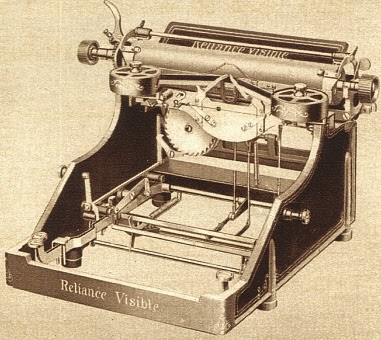
Above, the Reliance Visible (from the same sales catalog, Will Davis collection.)  The configuration of the machine is generally standard, although the openness of the area around the type bars is notable when compared with just about any other standard make.  This machine does have some unusual operating features.  For example, the key seen protruding from the side of the machine here is the tabulator key, which also serves as the margin release.  Opposite it, on the other side of the typewriter, is the backspace key.  Paper release is effected by pulling the paper table forward.  The machine does have a two-color ribbon, and a target type indicator to tell which color is selected.

Immediately to the side of the type bars in the illustration above can be seen a key protruding from the top of the deck.  Pulling up this key releases the "keyboard" for removal, as seen below.

The Reliance Visible was normally sold with the Commercial Keyboard.  However, according to the sales catalog:

"..we can furnish two regular foreign keyboards. One of these can be used to write French, Spanish, Portuguese or Italian, and the other for German, Swedish, Norwegian, Finnish or Danish.  We can also supply special keyboards for languages such as Greek, Russian, Bulgarian or Croatian. These keyboards can either be purchased separately or fitted on your machine when you order it.  The arrangement of letters on these foreign keyboards is exactly the same as on the English."

Further, four type styles were available:  Pica, Medium Roman, Elite, and Small Italic.   Pica and Small Italic were 10 cpi,  Elite 10 cpi and Medium Roman about 8 cpi.


Other features of the machine included the following:

•44 keys, 88 characters
•Tabulator with six stops as standard equipment
•Ball bearing carriage
•Single, double and triple line spacing; includes ratchet release
•Adjustable paper fingers
•Type face protection (projections on rear of type bars)
•Extra wide paper capacity (paper width 10-1/8 inches, writing line 9 inches)

The Reliance Visible itself, catalog item 157L8503 was $48.50 with a shipping weight of 58 pounds including machine, shipping crate, metal case, rubber dust cover, typewriter brush, oil, two ribbons (one blue or black and one two-color) along with instructions.  The net shipping weight was 25 lbs.

Extra keyboards, catalog item 257L8506 were available for $30.00 and had a shipping weight of 20 pounds. Available in four type styles, with languages and styles noted above.

Reliance Visible Examples

We own three Reliance Visible machines; two are shown and briefly described below.  The third is a parts machine, and is not different from the first unit shown below.

Reliance Visible serial 51695, Davis Bros. collection
The machine you see above was actually purchased along with the trade catalog whose illustrations we've been showing.  The catalog had a letter from Ward's to one Enos Lesh, with a date of October 28, 1916 about sending for the trade catalog.  Letterhead on this is labeled "Montgomery Ward & Co. - Reliance Visible Typewriter Division."   Hand written inside the catalog is "Mar 4-1917 Enos Lesh."  Thus we can pin the date of this serial number in the first quarter of 1917.  This concern did not make more than about 12,000 typewriters from late 1915 through perhaps 1922 or 1923.

Serial numbers for known examples jump from the 41,000 range for the last of the Pittsburgh machines to a new 51,000 range for the first of the Reliance machines.


We tested this machine and found it to be fairly pleasant to use.  The type action is not strong - having somewhat of a delicate feeling - and is not conducive to exceeding high speed.  The control of backspace is clumsy, being located on the outside and pushing inward.  However the shift (which is segment shift) is among the lightest ever tested here and is a real high point of typewriter design in terms of its ease of operation.  Other controls are workable, if unusual; the paper release via paper table is novel, and the line space is functional if not excellent (it in fact duplicates that on the Emerson exactly.)

Reliance Visible, serial 60800, Davis Bros. Collection
The machine above displays two significant changes.  First, the line space lever is totally different, as is the whole line space mechanism.  More important to historians is the decal on the front top of the keyboard, which now says "Reliance Machine Mfg. Co." instead of saying "Reliance Typewriter Co." as before.  This latter name has been found a number of times in various corporate records references, but the exact date of the change in corporate name (and perhaps ownership) is not known.  In all other respects however this is essentially the same typewriter.

Reliance Visible catalog, courtesy PETER WEIL
The trade catalog cover illustration sent us by Peter Weil, seen above, actually matches the later version of the Reliance Visible shown in actual example above.


Above, we see an illustration from Peter Weil, showing the AMERICO.  This relabeled variant is physically the "high deck" version of the very late Pittsburgh Visible and Reliance Visible machines, which is far more enclosed and which looks much more like other standard machines of the day.  Collectors like these because of the range of relabelings seen applied to them.  These "high deck" variants are much less common than the machines otherwise shown on this page and were never advertised or shown in Montgomery Ward ads or materials.  Note the line space lever, which matches that on the late style Ward's Reliance Visible shown earlier, serial 60,800 and on the late trade catalog cover.

Reliance Visible - In Retrospect

Today as collectors, we view the Reliance as somewhat of an oddity.  The machine definitely falls into two brackets we seem to like to apply retroactively to typewriters:

•First, the machine was a "lower priced" standard. Many of these failed, and because they did they're not common and are thus more prized by collectors.

•Second, the machine had a removable major element.  While many typewriters had quickly removable carriages (for interchange with wider ones, as an example) many fewer makes had major interchangeable units like this.

In total, the Reliance Visible didn't sell more than about 12,000 machines from perhaps late 1915 through the early 1920's when it was taken off the market.  This is neither a total failure nor a major impact, and it looks as if the Reliance was not a make that drove events in the industry.  The sea was very full of very big fish by the late teens and early 20's -- and a recession in the early 20's killed off a large number of makers (including Fox and Victor.)

Sales-by-mail was an increasing problem around this time; early on, this was workable with lower priced machines (and helped enable lower prices by omission of sales forces and offices) but the enormous flood of rebuilt machines everywhere - often of highly variable quality - made inexpensive typewriters rather easy to come by.   Thus the "middle ground" between brand new $100 machines sold under one to three year contracts with service available at all times, and rebuilt machines for $25 to $50 which were a couple years old but solid was almost completely untenable.  This is further hinted at by Royal's move out of the $65 (Royal Standard, Royal No. 1) and $75 (Royal No. 5) range up into the true $100 range in 1914 with the Royal No. 10.  The middle ground was clearing out, fast.

(Speaking of mail order.. Oliver Typewriter Company famously ditched its sales organization in 1917, letting go 15,000 sales people and closing its city offices; the company converted to direct by mail sales.  This allowed it to drop its price from $100 to $57 but could not save the company.  It would have done better to develop a four bank front strike typewriter.  This seems obvious today, but such things were not obvious at the time in a seriously competitive market -- and some bad decisions were made.  I note this to indicate the range of actions being taken by companies in those days -- and also to note the move of the established Oliver make from the high priced bracket down into the price bracket of the Reliance Visible and of the Harris Visible / Rex Visible.)

The fine appearance of these machines when found in good condition makes them desirable, as does their somewhat unusual profile.  Typists could be frustrated by these, as they reward only a precise technique and very steady rhythm and perhaps worse they're difficult to repair.  Historians will note the connection between the typewriter and Montgomery Ward, and will engage in making comparisons between the efforts of these concerns and those of Sears, Roebuck and Harris.  The idea that a range of disparate products could be sold by, and guaranteed under, the brand name of a distributor and not the original manufacturer was continuing to gain broader acceptance at this time; it led to the popular department stores of major cities of later years, that lasted through the 1990's when their decline began.  Thus, collectors who have fond memories of shopping at such stores in days of old may particularly enjoy the department store historical connection of the Reliance Visible.


Whatever the case, while the Reliance Visible is not terribly important to typewriter history, it is a part of it and is the end of a famous and visionary line of typewriters which, in the final analysis, were not substantial enough to stand up to the heavier, more well optioned $100 machines which had sales and service networks behind them or the flood of inexpensive rebuilt machines which themselves were just older models of the big makes on the market.

For more information:

Read about the Sears, Roebuck effort to sell the Harris Visible (as mentioned above) here.

See the letter from Ward's to Enos Lesh about the Reliance Visible here.